sh|ft feat. Landesjugendensemble Neue Musik Baden-Württemberg
Multimedia piece development in a collective
Large working phase of LJE Neue Musik from 31 Aug – 06 Sep 2024 at Musikzentrum Baden‑Württemberg
with a final concert on 6 September 2024 at the Kulturzentrum Dieselstraße Esslingen.
For the working phase with the Landesjugendensemble Neue Musik Baden‑Württemberg, sh|ft developed an educational concept under the label “Doing Expanded Music”. With this, sh|ft addresses a central aspect of its own practice, which goes beyond merely interpreting modern repertoire and uses its own performance techniques: the role of the composer‑performer, developing and staging pieces within the collective. The working phase proved successful in that teenagers experienced a broad spectrum of collective multimedia composition. The resulting program includes, besides a piece by Johannes Werner for nine performers and smartphones – programmed by Hannes Brugger – a live‑audio‑visualised work produced by the ensemble, as well as two adaptations of historical avant‑garde concepts reinterpreted with contemporary means.
The concept is built on three core principles:
- Decisions are made collaboratively rather than hierarchically. The ensemble, as a group, goes through every production‑relevant working phase – from content selection and material gathering, to conceptual discussions, improvisation, creation of fixed‑media elements, all the way to aesthetic design and performance situation.
- The pursuit of expanding instrumentation across multiple media layers: multimediality is not simply added on but actively constructed. During pre‑production as well as in the live moment, camera work, video editing, lighting, animation are all handled by participants – just like sound generation and improvisational design.
- The tools and instruments used should be acquired at minimal cost so that the knowledge gained can be transferred to one’s own musical practice.
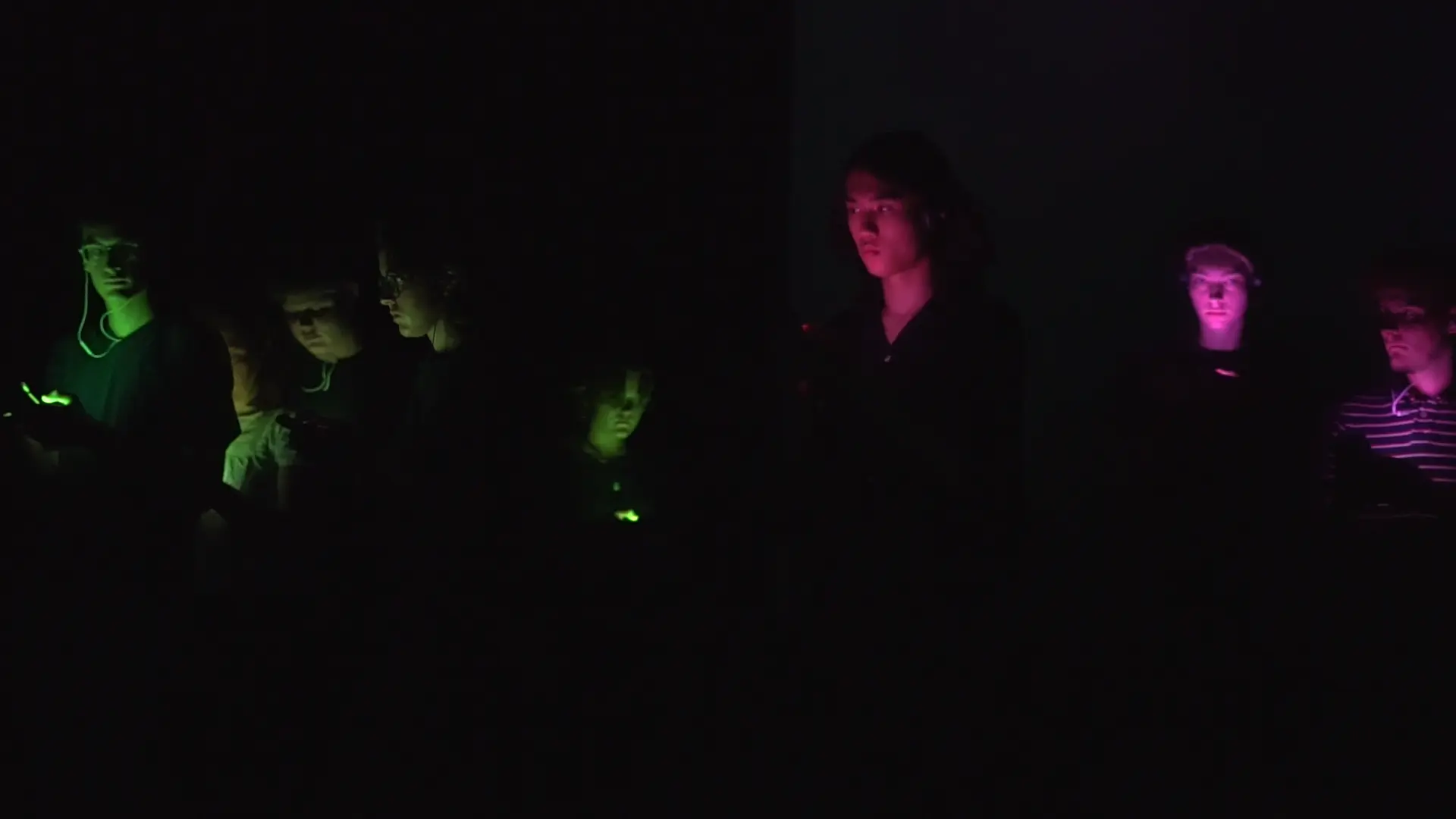
In hashed moments by Johannes Werner and Hannes Brugger, smartphones serve as central communicative agents within the stage infrastructure – acting as sound and light sources as well as cameras. In a custom‑programmed network structure, performers interact with themselves and the audience. They move through anarchic live chat rooms, experience moments of community and isolation, limitless expressive possibilities, collective helplessness, and misinformation. The performances confront today’s multimodal, networked communication society with endless loops of a archaic, one‑dimensional telephone usage.
Over the course of the week, a small library of various historical avant‑garde concepts from experimental music and sound art was displayed to discuss possibilities for reinterpretation and transfer onto contemporary means. Two such concepts were approached in very different ways:
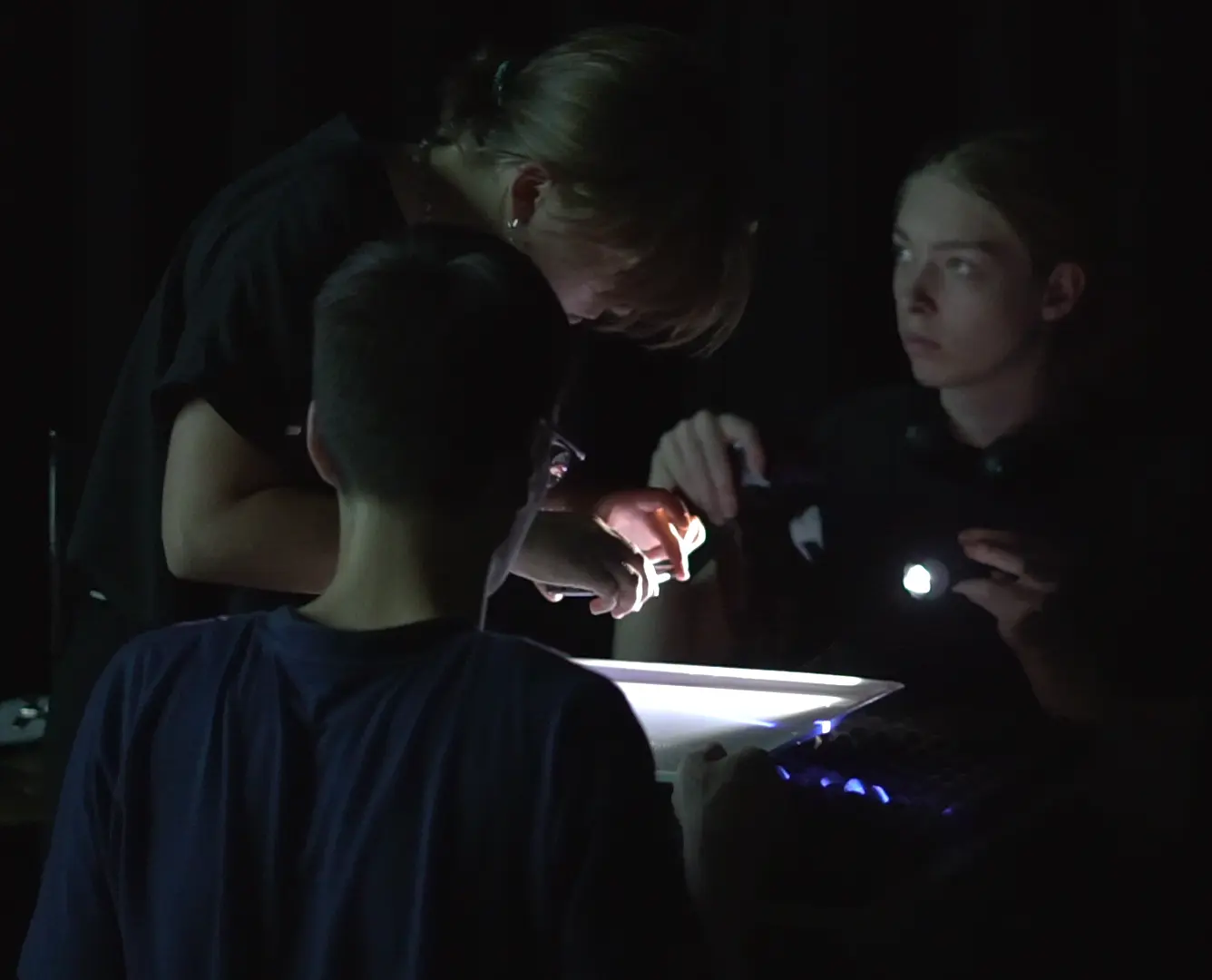
Alvin Lucier’s Queen of the South served as a basis for creating analog live visuals from sound waves, made visible via smartphones and projectors. In a multimedia laboratory, sound was generated with transducers in wavefields and water surfaces, orchestrated by manually guided light, filmed on smartphones, and projected live.
Terry Jennings’ Piano Piece (1965) is based on piano chords held as long as possible. The LJE developed an interpretation for the entire ensemble’s instrumentation. The prolonged decay of the sounds is achieved through digital spectral‑freeze effects.
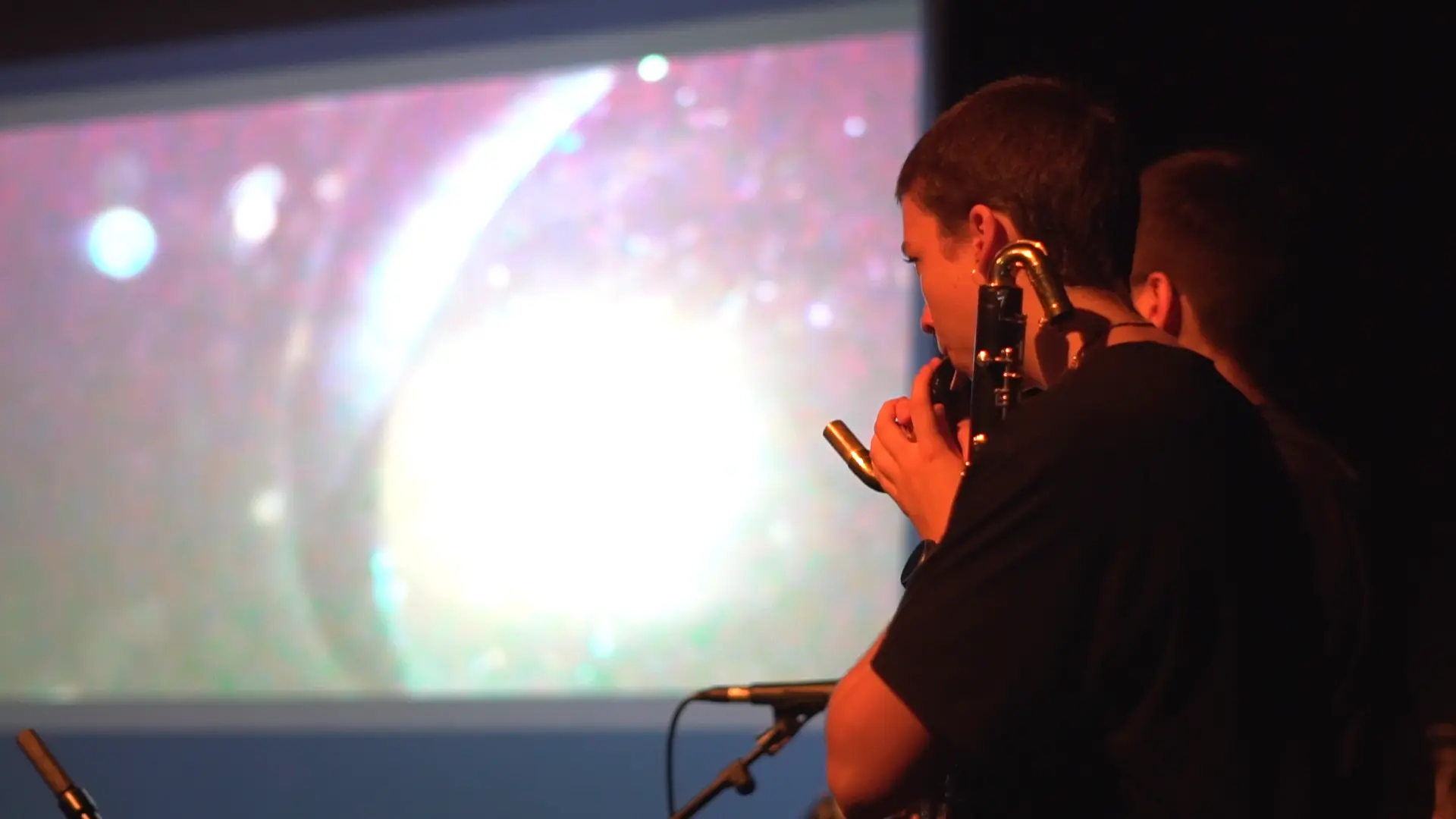
Kraftwerk, the central self‑production of the working phase, is a live‑audio‑visualised video work. Endoscope cameras capture close‑up footage of the inner workings of the instruments, which are edited into a 15‑minute silent film. In intensive improvisation sessions, live audio was developed to accompany it. Precise camera movements and lighting focus on the mechanical elements of the instruments, while elaborate editing techniques and effects create images that oscillate between surrealist and futuristic machine spaces. On stage, these visuals confront their outer shells and the performers that play them.