gesture/control
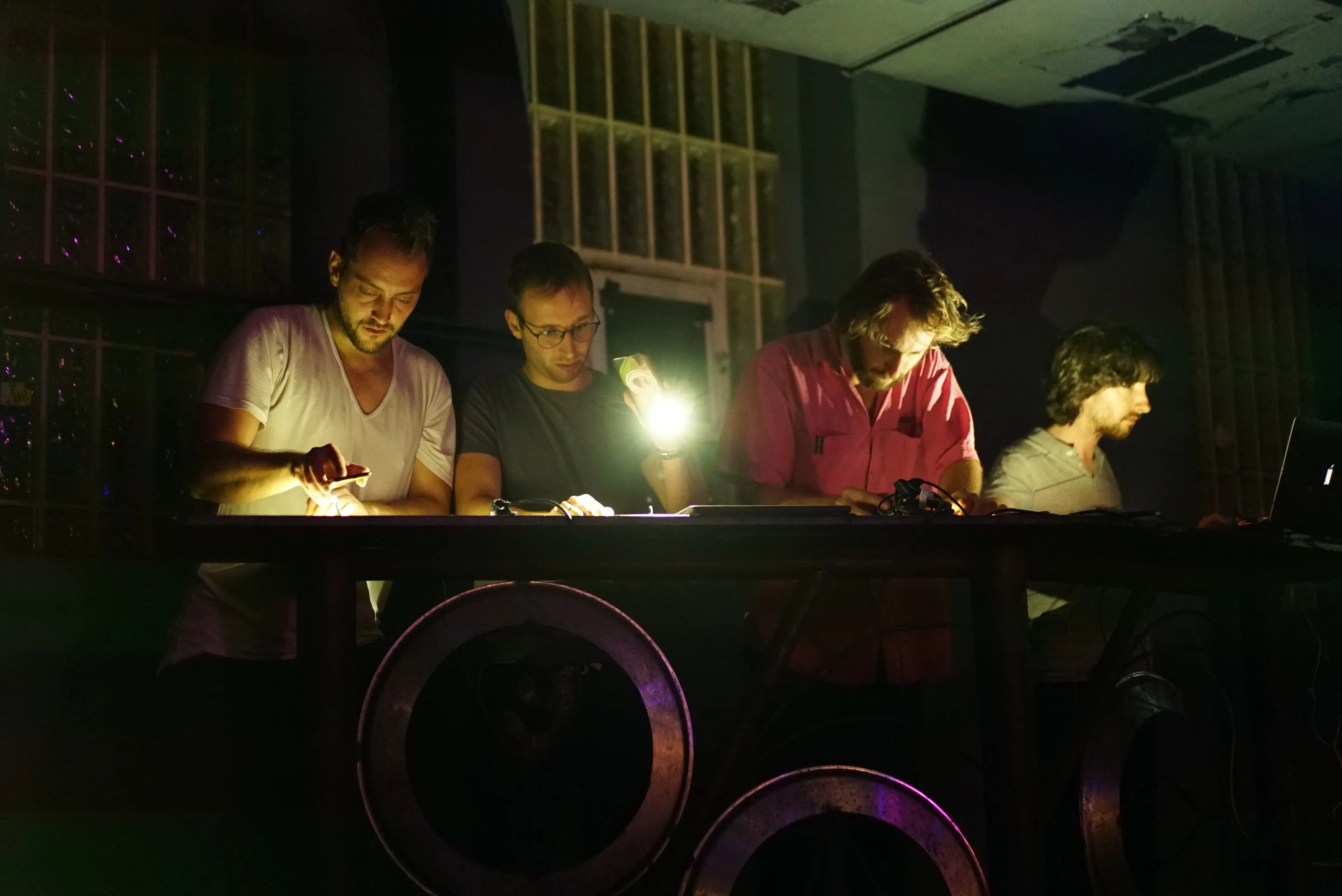
The project “gesture/control” by sh|ft revolves around working with various types of sensors, tracking movements, reacting to light, and manipulating particle systems. It is the result of roughly a year of artistic and technical research carried out by the ensemble – a process that sh|ft views both as an opportunity to explore new artistic possibilities and as a challenge to discover alternative ways of dealing with non‑artistic material in order to create art. By combining sensors in different configurations, sh|ft has produced several miniatures. Each miniature investigates a distinct element: some probe the limits of what the sensors can capture and deliberately operate at the edge of technical feasibility; others aim to establish new causal relationships between different sensor types. In addition to performative miniatures, there are also works with an installative / hybrid character.
Miniature 1:
A crate containing an LED light is placed on a table, the open side of the crate facing downwards. A light sensor is mounted on the table and a motion sensor is attached to the box. With minimal movements, the performer alters the position of the box (activating the motion sensor) while simultaneously allowing some light to escape from the box, triggering the light sensor. The data from both sensors are then translated into an acoustic landscape that responds to what happens with the crate. The audience experiences this sonic environment and perceives how changes in light and position directly influence what they hear.
Miniature 2:
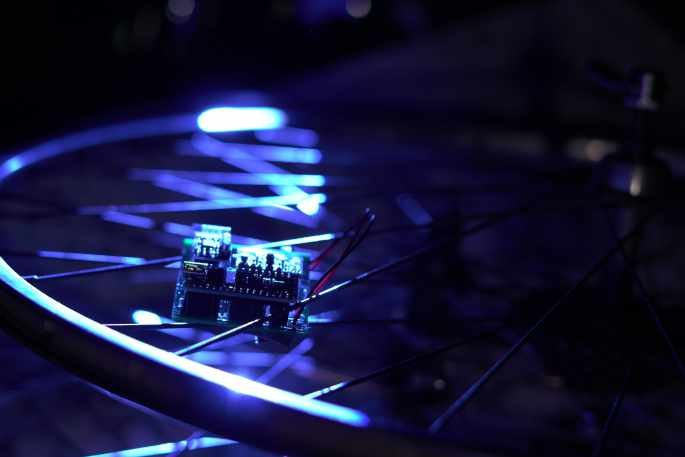
Miniature 2 is a participatory sound installation that explores the periodic nature of wheel rotations. Several wheels of varying sizes are positioned in space, ready to be set into motion. The periodic circular movements are captured live by accelerometers and control low‑frequency oscillators linked to the wheels’ rotational speed. This installation creates a playground for controlling analog pulsations: synchronization and phasing techniques become visible and tangible through the wheels’ motions. From this emerges a sonic world of pulses, polyrhythms, and aleatoric structures.
Miniature 3:
A particle system represents fundamental physical laws such as velocity, gravity, or lifespan. This dynamic depiction of chaotic behaviour meets the point‑wise presence of a performer. An audiovisual duet is born between the computational model and the performer, who influences and directs the representation with physical movements. Here, multidimensional perception of sound and space takes center stage.
Miniature 4:
Miniature 4 investigates the human body as an instrument for self‑expression through stereotypical movements and gestures of live musicians. Movement artefacts that enhance musical expression or illustrate a sonic concept have been established over centuries of concert practice, yet they often contribute little to sound production in purely physical terms. From this repertoire of bodily expression emerges choreography that is measured and interpreted using various sensors attached to the performer’s body. The choreography triggers or radically deforms sound material. It layers movements with high recognisability into audiovisual jingles and pushes performances toward absolute physical exhaustion, demanding ever more extreme portrayals of recurring expressions in a competition for visibility.